


SEARCHING FOR HEFFALUMPS:
EXPLORING WINNIE THE POOH'S REAL-LIFE HUNDRED ACRE WOOD
Last updated: December 13, 2025
There’s something really grounding about actually stepping into the same sun-dappled woods that once sparked the imaginations of A.A. Milne, E.H. Shepard, and—years later—the Disney animators who brought Winnie the Pooh to life in 1977. As I wandered along the crooked paths of Ashdown Forest, I couldn’t shake the feeling that I’d somehow wandered into the story itself. I half-expected Pooh or Piglet to appear from behind a bush at any moment, politely asking if I happened to be carrying a little something sweet.
This post is my journey through the real-life Sussex locations that inspired the Hundred Acre Wood. While it technically centers on places that influenced The Many Adventures of Winnie the Pooh (1977), I figured that if you’re making the trip out here at all, you might as well go all in. So consider this a deep dive into all things Pooh. Whether you’re planning a full Pooh-themed pilgrimage or just looking for a hit of nostalgia, think of this as your map to the “Wood”—a place that, as Pooh so perfectly reminds us, is always bigger on the inside.
getting here
BY CAR:
Driving is the most flexible way to explore all the scattered, tucked-away corners of the “Hundred Acre Wood.”
-
Distance: ~35 miles from central London to Hartfield.
-
Travel time: 1.5–2 hours depending on traffic.
A car lets you hop between locations—especially the more remote ones like The North Pole and Eeyore's Sad and Gloomy Place—without relying on long forest walks. Parking is available at several Ashdown Forest parking lots (or car parks as the call them in the UK).

BY PUBLIC TRANSPORT:
Public transit is surprisingly simple—just a little slower and requires some extra walking.
-
Train: London (from Central London, I would suggest London Bridge or London Victoria) → East Grinstead. Schedule here.
-
Bus: From East Grinstead, take local buses toward Hartfield or Forest Row and alight at the "Church" bus stop. Schedule here.
Once you reach Hartfield, you'll be able to to wander at a Pooh-like pace (“the nicest pace there is,” as he might say) to see all of the Winnie the Pooh related sites. Note: I’ve listed the sites in the order you’d naturally come across them when setting out on foot from Pooh Corner.

pooh corner
My day naturally began at Pooh Corner, which really is the perfect starting point—especially if you’re arriving by public transport, since it sits just steps from the Church Street bus stop in Hartfield. It’s part café, part gift shop, and entirely charming. I grabbed one of their maps, browsed shelves filled with Pooh memorabilia, and seriously considered one (okay, more than one) Pooh-themed treat. It’s also one of the best places to get your bearings before heading into the forest, and if you’re lucky, you might even hear a local story or two from the staff—who seem to know Ashdown Forest almost as well as Owl knows his letters… well, nearly.
cotchford farm
If Ashdown Forest is the landscape that shaped the Hundred Acre Wood, then Cotchford Farm is where the stories truly began—and visiting it feels a little bit special. A.A. Milne bought this farmhouse in 1924 as a quiet escape from London, and standing there, it’s easy to see why. This was the backdrop for long summer days, lawn parties, and unhurried walks through the forest, where Milne watched his son play with a certain bear named Edward. Those ordinary moments—nothing grand, nothing planned—slowly turned into stories that would go on to enchant generations.
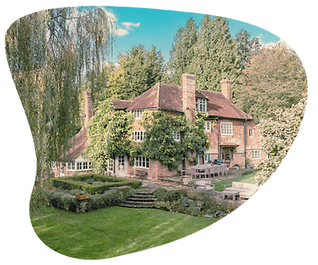
What makes Cotchford Farm even more magical today is that you can actually stay here. The farmhouse has been thoughtfully transformed into a cozy retreat, and spending time on the property really does feel like stepping into Pooh’s world. I wandered through the gardens where Christopher Robin Milne once played, paused to admire the statues and small tributes to the characters, and soaked in the quiet mornings that feel wonderfully unchanged.
That said, it’s important to note that Cotchford Farm is a working, privately run accommodation, not a public attraction. If you’re not staying here, this is one location you may want to admire from afar—or skip entirely—out of respect for the guests and the property itself. For those who do stay, though, it’s incredibly special. Being just a short walk from many of the real-life locations that inspired Pooh’s home makes Cotchford Farm not just a place to visit, but a place to truly settle into the Hundred Acre Wood.
pooh's house
Just off one of the forest trails, I stumbled upon Pooh’s House—a small, wonderfully humble little structure built by fans and lovingly cared for by the local community. It isn’t an official landmark, and honestly, that’s part of what makes finding it feel so special. There’s no big sign announcing it; you kind of just… find it. And when you do, it’s impossible not to picture Pooh living quietly inside, minding his own business and thinking about his next snack.
What really caught my attention were the small offerings visitors leave behind, most famously little pots or drizzles of honey. I saw tiny jars, honey sticks, and a few handwritten notes from children wishing Pooh a good day. While it’s important to be mindful of wildlife and avoid leaving anything harmful, the intention behind it all is incredibly sweet. Standing there, it felt like a quiet reminder of how deeply these stories stick with people—long after childhood—and how a simple bear in the woods can still inspire kindness, imagination, and a little bit of magic.

poohsticks bridge
No visit to the Hundred Acre Wood would feel complete without stopping at Poohsticks Bridge, and somehow it ended up being one of the most joyful places I visited all day. The bridge sits quietly over a gentle stream in Ashdown Forest, surrounded by tall trees that sway just enough to make you wonder if a blustery day might be on its way. Standing there, it’s easy to slow down and simply take it all in.
This is the very spot where A.A. Milne played the first-ever game of Poohsticks with his son, Christopher Robin, turning a simple walk into a story that would last for generations. That small moment went on to become one of the most beloved scenes in the books—and later in Disney’s 1977 film. While the bridge you cross today is a careful reconstruction from 1999, it still feels completely true to the original: simple, sturdy, and absolutely perfect for dropping sticks into the water and cheering them on.

piglet's house and owl's house
Two of the most charming—and most easily overlooked—landmarks in the real Hundred Acre Wood are Piglet’s House and Owl’s House. They sit close to one another along the forest walk, but if you’re not paying attention, you can stroll right past without ever realizing you’ve missed two of Pooh’s dearest friends.
Piglet’s House came first, tucked down low near the base of a tree, just as you might expect for a very small animal living in a very big forest. The spot is marked subtly—no grand sign, no fanfare—so keep your eyes close to the ground as you follow the path.

A short walk uphill brings you to Owl’s House, which sits higher up in the trees, echoing Owl’s status as the self-appointed intellectual of the group. The original tree that inspired E.H. Shepard’s illustrations once stood proudly here fell decades ago, but the area still carries the same lofty feeling—a perch where Owl might hold court, offer advice, or explain something entirely unnecessary but very confidently.
the enchanted place
From Owl's House, I passed through the Pooh parking lot (car park) and crossed the street to walk up the hill through the forest. Near the top of the Ashdown Forest ridge lies The Enchanted Place, known in real-life as Gills Lap—a sweeping viewpoint that offers some of the most breathtaking scenery in all of Pooh Country. This isn’t just another stop along the walk; it’s one of the most emotionally meaningful places in A.A. Milne’s stories.
This is where, in The House at Pooh Corner, Christopher Robin and Pooh share their quiet final conversation before the boy grows a little older and life begins to change. Standing there myself, it was impossible not to think about that moment. It’s a place where time slows down, just enough for you to feel the weight of memory.

It also made complete sense why this spot left such an impression on E.H. Shepard, and later on Disney’s animators. The gentle slopes, muted colors, and sense of calm are all echoed in the soft watercolor backgrounds of the 1977 film. Being there in person, you can trace that feeling straight back to this hillside—the nostalgia, the quiet beauty, and that slightly bittersweet sense that some places stay with you long after you’ve left.
a.a.milne and e.h. shepard memorial

At the very top of The Enchanted Place, you’ll find a quiet, unassuming memorial dedicated to A.A. Milne and E.H. Shepard—the author and illustrator whose partnership gave life to the Hundred Acre Wood and every character who inhabits it. It’s easy to miss if you’re not paying attention, and it doesn’t demand your focus. Instead, it blends gently into the landscape, which somehow feels exactly right.
The inscription on the plaque reflects the enduring partnership between the two men, a reminder that the magic came from the harmony between Milne’s gentle prose and Shepard’s expressive line drawings. In a way, this memorial honors not just the creators themselves, but the creative chain that began here and continues to shape how we imagine Pooh’s world today.
heffalump trap & roo's sandy pits
Tucked among the heathland south of Gills Lap lie two of the more whimsical stops on a Pooh-inspired walk: the Heffalump Trap and Roo’s Sandy Pits. Unlike more literal landmarks such as Poohsticks Bridge or Piglet’s House, these spots invite you to lean fully into your imagination—because that’s exactly how they were meant to be experienced.
The so-called Heffalump Trap is really just a sandy hollow in the forest floor, shaped over time by weather, wildlife, and wandering feet. But in the world of Pooh and his friends, this modest dip in the earth became the scene of grand adventure—where Pooh and Piglet once plotted to capture a fearsome (and entirely fictional) Heffalump.

Just beyond the Heffalump Trap, you’ll find Roo’s Sandy Pits—a series of naturally occurring sand depressions perfect for the kind of energetic play Roo was known for. These hollows are open, sunlit, and shaped like soft scoops in the landscape. Children tend to run up and down them instinctively, and I even found myself climbing down the slopes.
a little fork in the road
Before you continue deeper into the forest, it’s worth taking a moment to consider your return journey—especially if you arrived by public transit.
For drivers or for those seeking a longer, more adventurous walk, this is the perfect moment to carry on toward the remaining landmarks. The paths ahead wind deeper into Ashdown Forest and give you that wonderful feeling of wandering where the map edges start to curl.
However, if you’re relying on the bus back to East Grinstead station, remember that the return stop—the “Garage” bus stop near Hartfield—is not right around the corner. If your legs are beginning to feel a bit like Pooh after a particularly large pot of honey, you may want to think of this as a natural end point. There is absolutely no shame in turning back here; in fact, Pooh himself would probably approve of a sensible decision followed by a snack.
the north pole (sort of)
If you decided to continue on like me, the next cheerful landmark on the trail is The North Pole. In Winnie-the-Pooh, the North Pole was “discovered” by Christopher Robin during the mission to rescue Roo—an event that became one of the most memorable, free-spirited moments in the books.
The real-life North Pole in Ashdown Forest is more symbolic than scientific, of course, but that’s what makes it so delightful. Standing beside it, you can almost hear Pooh asking what, exactly, a North Pole is for, and Piglet nervously pretending he knew all along. It’s also a great spot for a quick photo, the kind that captures the playful spirit of the walk and reminds you not to take any of this too seriously.

eeyore's sad and gloomy place
Not far from the North Pole lies Eeyore’s Sad and Gloomy Place, a small patch of the forest that feels ever-so-slightly dimmer and quieter. It’s exactly the sort of place you can imagine Eeyore selecting for his house: tucked away, a little forlorn, but with a gentle kind of beauty.
In the movie, Eeyore’s home was famously rickety and famously temporary—always falling over, always being rebuilt by well-meaning friends. The landscape here mirrors that feeling: a subtle clearing surrounded by leaning trees and uneven ground, as if the forest itself can’t quite decide how cheerful it wants to be.

This is another location where imagination fills the gaps. There isn’t a constructed house here, nor a sign proclaiming gloom. Instead, it’s the atmosphere that does the work. It creates a setting where you can almost hear Eeyore sighing thoughtfully before saying something surprisingly profound.
And that's everything! Returning from Ashdown Forest feels a bit like waking from a dream—one filled with honey jars, rumbling hums, and the excitement of a small adventure. Walking the real paths that inspired Milne, Shepard, and Disney’s animators gave the 1977 film a whole new depth; suddenly the world of Pooh isn’t just imagined—it’s rooted in real English countryside.
If you decide to follow this trail, pack good shoes, a sense of nostalgia, and maybe a pot of honey (you never know who you’ll meet) or your personal favorite snack. As Pooh wisely says, “We didn’t realize we were making memories, we just knew we were having fun.” So here’s to making a few new memories in the Hundred Acre Wood—one Poohstick at a time.
And since nearly every Pooh-inspired journey will likely lead you back toward London, don’t forget to explore some of my London adventures—your story doesn’t have to end at the edge of the forest.
.png)


.png)
Beautifully written - I thoroughly enjoyed reading about your wonderful day out - thank you.
I must plan a visit there 😊