


THE SEARCH FOR THE LOCH NESS MONSTER:
TRACING THE REAL SCOTLAND BEHIND THE BALLAD OF NESSIE
Last updated: February 1, 2026
Welcome back! Or if this is your first time here, hello, pull up a chair, and please accept this complimentary imaginary tartan scarf. Today we’re heading to one of the most legendary, mistiest, and monster-est places on Earth: Scotland’s Loch Ness, and specifically the real-life locations that inspired Disney's delightfully quirky short, The Ballad of Nessie. Yes...that Nessie.
For those of you who haven't heard of it before, there's a legend that a monster (nicknamed Nessie) lives in Loch Ness.The first recorded mention of this monster dates back to 565 AD, when Saint Columba supposedly encountered a “water beast” in the River Ness. But modern Nessie-mania really kicked off in 1933, after a new road was built alongside the loch (ironic, given that The Ballad of Nessie is literally about new construction destroying her home). Since then, there have been blurry photos, sonar scans, and at least one guy in a homemade dinosaur costume. And yet… the mystery remains.
So I decided to go for myself (armed with a rain jacket, Google Maps, and an unreasonable amount of optimism) to see what all the fuss was about. And I can tell you that the animators nailed it on all things Scottish. So today, we’re tracing their footsteps from Inverness all around the loch (which means lake in Gaelic), blending folklore and practical travel tips along the way.

We’re starting in Inverness, which is basically the unofficial capital of the Scottish Highlands and your main gateway to Loch Ness. You can do Loch Ness as a day trip from Inverness… but honestly? Don’t. There’s too much to see, too much atmosphere to soak in, and too many gift shops selling plush sea monsters.
Just to give you an idea of the breadth of this journey, this isn't like visiting your typical lake. Loch Ness is 23 miles long (37 kilometers), about one mile wide (~1.5 kilometers) and has a depth of up to 755 feet (~230 meters) in some locations. There's so much water in this lake that you could fit all of the freshwater in England inside of it. Which means if Nessie is real, she has more than enough room to avoid everyone.
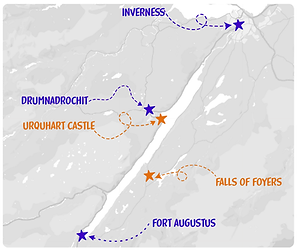
By Tour:
There are several companies who have either dedicated full tours to trips around the loch or included it as part of a larger Scottish Highlands journey. If you want a fully stress-free experience and don't mind being shuttled around with specific drop off/pick up times, definitely check out the tour options. I would suggest searching "Loch Ness Tours" and you'll be able to find whichever option that tickles your fancy.
By Car:
Driving is the easiest way to see all the sites and build out your own timetable. There are available parking lots (car parks) along the journey and you shouldn't have any issues navigating around the Loch. Even for those people who aren't used to driving on the left side of the road, it's a pretty peaceful, scenic route so you won't encounter many (if any) difficulties.
-
Distance: ~70 miles (113km) to do a full circuit from Inverness, around the loch, and back to Inverness
By Public Transport:
The ease with which you can do this journey by public transport really depends on the time of year that you're traveling. From everything I've researched, there are more buses available during the on season (May - October) which makes it much easier to plan your trip around the Loch. I went during the off season so I can assure you that it's still doable, but will require more planning. The Stagecoach website, Scottish Citylink website and Google Maps are going to be your lifeline so make sure that you check them for your dates of travel to ensure that you have the correct bus timetables.


Our first stop sits on the quieter, less‑visited southeastern side of Loch Ness: The Falls of Foyers. If you're taking the bus from Inverness, make sure to request a ticket to the Upper Foyers Shop. Once you make it to either the parking lot (car park) or bus stop, it’s about a two‑mile walk to the falls. It's definitely manageable and I say that as someone who is definitely not a hiker. Just make sure you bring appropriate shoes and rain gear as you never know when the weather is going to turn in Scotland.
The falls themselves are stunning — a dramatic cascade plunging into a deep gorge, surrounded by mossy cliffs and ancient forest. The water here actually flows into the River Foyers, not directly into Loch Ness, which surprised me. If you want to reach the loch, it’s another 30‑minute walk, but it’s absolutely worth it. The path opens up to sweeping views that feel straight out of a watercolor background painting.

Next, we head to the southern tip of Loch Ness: Fort Augustus. If you're traveling via public transit, please note that this is where it gets a little tricky. As of when I did this journey, there is no direct bus from the falls to Fort Augustus so this is where the whole "you can't and/or shouldn't do this whole journey in a day" comes in. For my adventure, I headed back to Inverness following my visit to the falls and continued my journey after a nice rest. Once you're ready, I would suggest taking the bus from Inverness to the Fort Augustus Tourist Information stop.
This charming village is built around the Caledonian Canal, a 19th‑century engineering marvel that stretches from coast to coast across Scotland. The canal includes a series of locks — essentially water elevators for boats — and watching them operate is surprisingly mesmerizing. It’s like the slowest, most polite roller coaster you’ve ever seen.
Fort Augustus is also one of the best places to appreciate the sheer scale of Loch Ness. From here, the water stretches northward like a dark ribbon between the hills. It’s easy to see why Nessie stories thrive here — the loch feels ancient, mysterious, and just a little bit theatrical.

It's at this point in the blog where I also need to mention that you absolutely CANNOT leave Loch Ness without taking a cruise. There's many departure points, including Fort Augustus, and lots of different companies who operate around the loch. There's also many different experiences, from a quick jaunt around the loch to sonar readings to try your hand at finding Nessie. Sailings are offered throughout the day, though many reduce schedules or close entirely in the off‑season. Check timetables before you go, especially in winter. There’s nothing quite like gliding across the dark, mysterious waters while scanning the horizon for a ripple that might be Nessie… or a duck… or a particularly ambitious wave.


If there’s one place on this list you absolutely cannot skip, it’s Urquhart Castle. Perched dramatically on the western shore of Loch Ness, these ruins date back to the 13th century and have seen everything from medieval battles to Jacobite uprisings. Today, they’re one of the most photographed sites in Scotland — and for good reason.
To get here via public transport from Fort Augustus, you may have an easy one bus jaunt from the Fort Augustus Tourist Information Stop to the Car Park stop or Strone Urquhart Castle stop (depends on the bus) next to Urquhart Castle or you could have a fun three bus transfer adventure. It's really all dependent on the time of day that you're traveling and how many buses are traveling through during that time of year. I know I keep saying this, but it is imperative that you pre-plan all of your journeys and have a lot of patience if you are planning to do this trip as a DIY.
Once you've made it to the castle, your ticket includes a short introductory film (very well done), after which you’re free to roam the grounds. You can climb the towers, wander the grassy courtyards, and even dip your toes into Loch Ness. The photo ops here are unreal — every angle looks like a movie still.
In The Ballad of Nessie, you get several glimpses of the castle. From the beginning where we watch a bagpiper playing to Nessie climbing to the top of the tower to see her new home, there's lots of good shots of the silhouette and setting that match the real Highland castles that dot the region — especially Urquhart.

Finally, we make our way to Drumnadrochit, a village that has been intertwined with the Loch Ness Monster story for decades. You can get a bus from Strone Urquhart Castle or Car Park (depends on the bus) to the town and if you do this, you should get off at the Drumnadrochit Post Office stop. You can also have a leisurely walk on a nice trail back into the town and if you choose to do that, it's about 2.5 miles (4km).
While you can't reach the loch directly from Drumnadrochit, this is a very important town in the loch's history. This is where many of the early Nessie sightings were reported, and it’s home to two major attractions:
A family‑friendly, whimsical stop full of statues, displays, and photo ops. It looked very kitschy, very fun. I didn't have enough time to visit this location as I ran out of time due to a cancelled ferry from the Isle of Lewis (more to come on that in a future post).
This is the one I visited — and wow. I went in expecting something small and touristy, but they’ve transformed the old Drumnadrochit Hotel (a historic Nessie hotspot) into a genuinely impressive, interactive experience. The exhibits walk you through the history of the legend, the scientific investigations, the hoaxes, the cultural impact, and the ongoing research. It’s immersive, educational, and surprisingly emotional. At the end, you’re asked to decide: Are you a believer? A skeptic? Or somewhere in between? I’ll let you guess where I landed.

If you’ve made it this far, thank you for joining me on this misty, magical journey through the Scottish Highlands. Just to finish it off for those folks who chose the public transport route, there's just one more bus journey back from the Drumnadrochit Post Office stop to Inverness. Super simple and a nice way to cap off the end of this journey.
Exploring the real‑life inspirations behind The Ballad of Nessie gave me a whole new appreciation for the short — and for the landscapes that shaped it. Whether you’re a lifelong Disney fan, a Nessie enthusiast, or someone who just loves a good legend, Loch Ness is a place that stays with you. The hills, the water, the ruins, the stories — it all feels like stepping into a living fairytale.
Until the next adventure, friends — may your travels be magical, your photos be mist‑free, and may you always keep one eye on the water… just in case.